


Built for business. Engineered to perform
Commercial Garage Doors for Every Industry
G-4400 All-Glass Commercial Doors

One of the industry's strongest commercial full-view aluminum doors, for long-lasting performance. Proudly engineered and made in Canada.
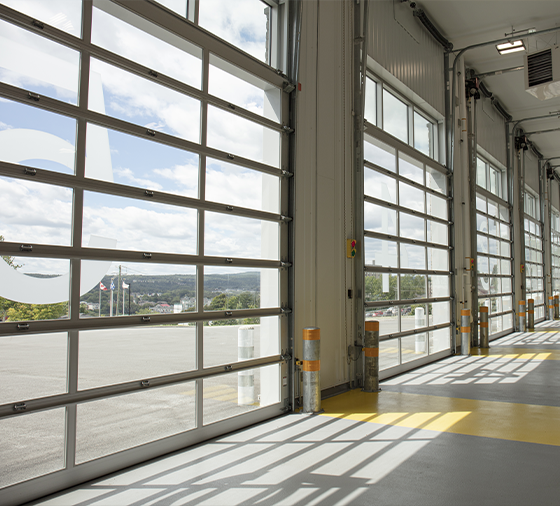
— 13-1/2'x14' all-glass doors, Anodized frame, Clear glass


Get your price now
Free QuoteG-5000 Steel Commercial Overhead Doors
Engineered and made in Canada. Well insulated, strong, durable, and highly customizable. Canada's leading commercial steel door since 1983.
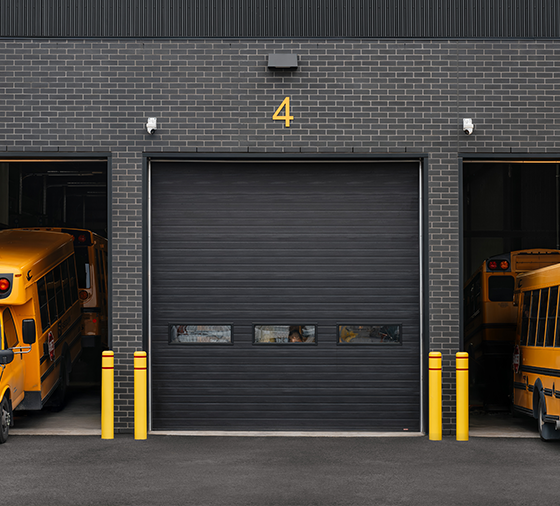
— 14'x14' doors, Grooved design, Black, Long windows, Uniform woodgrain steel

Get your price now
Free QuoteG-1000 Aluminum Commercial Overhead Doors
Lightweight aluminum construction for oversized doors and exceptional corrosion resistance. Proudly engineered and made in Canada.
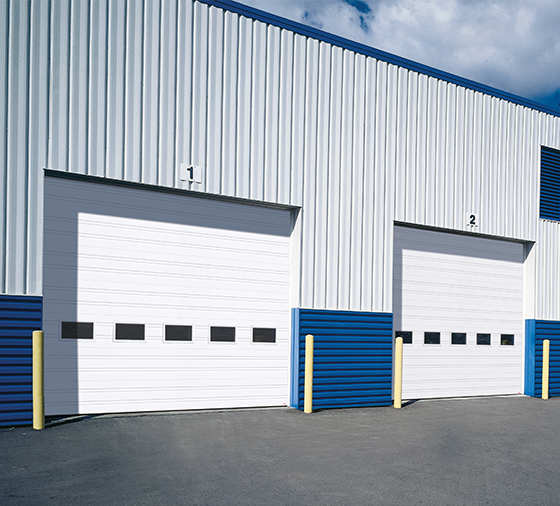
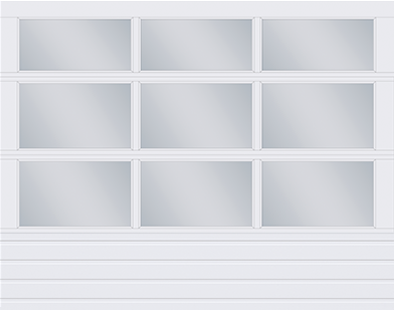
— 4 Grooves design, White


Get your price now
Free QuoteG-2020 Series Steel Commercial Overhead Doors
Designed for specialized applications requiring heavier steel gauges. Available in smooth steel with R-16 insulation. Proudly engineered and made in Canada.
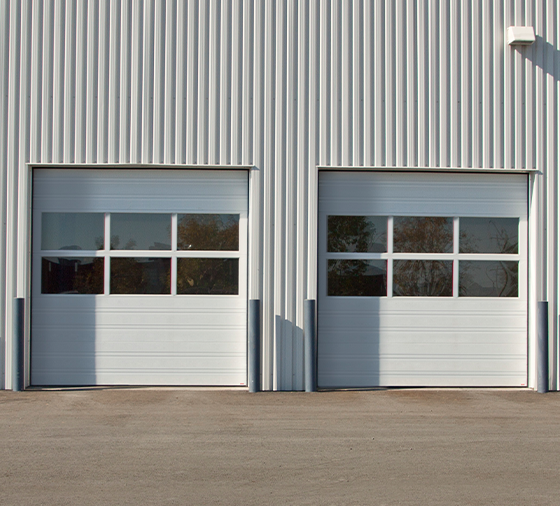
— 10' x 10' and 12' x 12' doors, Tex White, Full-view window sections, Smooth steel

Get your price now
Free QuoteOpen-Back 24-ga Steel Doors (OBI 2024HD & OB 2024HD)
Commercial steel doors for utility, agricultural and storage applications. With or without insulation.
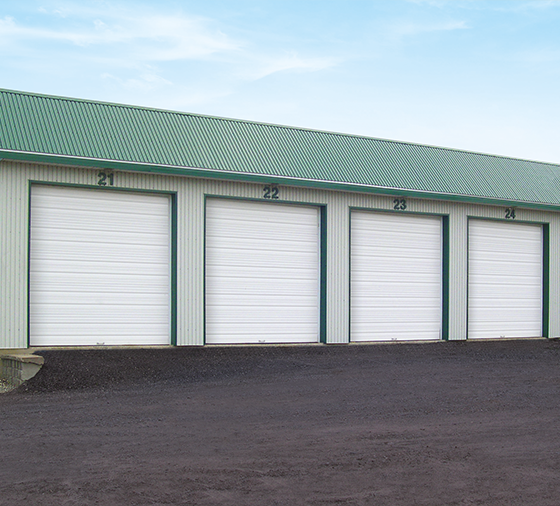
— 10'x 10' doors, Deep Grooves design, Commercial White, Smooth steel

Get your price now
Free QuoteFAQ
Yes. The doors in this range are sectional overhead doors, built from horizontal panels that travel up and along the ceiling track. Garaga's pages describe them as commercial overhead doors, and models range from lightweight aluminum to heavy-gauge steel for shops, warehouses and industrial buildings.
It depends on use. The G-1000 is a lightweight aluminum door suited to oversized openings and corrosive environments. The G-2020 and G-5000 are steel doors for heavier-duty or well-insulated applications. The G-4400 is a full-view aluminum door for storefronts or showrooms. The S-24 is an open-back steel door for utility, agricultural and storage buildings.
Steel doors like the G-2020 and G-5000 suit heavier-duty and specialized applications, with the G-2020 available in heavier steel gauges. Aluminum doors like the G-1000 are lightweight, suit oversized doors and resist corrosion well. The G-4400 is a full-view aluminum door for glass storefront applications.
R-values vary by model. The G-1000 and G-2020 offer R-16 insulation. The G-5000 offers R-12, R-16 or R-18 depending on thickness. The S-24 offers R-7.2 insulation or a non-insulated option. The G-4400 full-view door is non-insulated.
Yes. The S-24 open back steel door is available insulated or non-insulated, and the G-4400 full-view aluminum door is non-insulated. Insulated options such as the G-1000, G-2020 and G-5000 use polyurethane or polystyrene fill depending on the model.
No, Garaga's commercial range is built as sectional overhead doors rather than roll-up doors. Each door is made of horizontal panels, as seen in the aluminum, steel and full-view glass models described on this page.
Commercial doors are built heavier. Residential doors run 1-3/8'' to 2'' thick with 2'' track hardware, while commercial doors range from 1-3/8'' to 3'' thick and use 2'' or 3'' track with thicker steel. Residential springs are rated for about 10,000 cycles for roughly two openings a day; commercial dock doors can cycle 25 to 50 times a day with springs rated 25,000 to 100,000 cycles. Residential openers run 1/2 or 3/4 HP on 115V; commercial openers run 1/2 to 1 HP on 115, 220 or 575 volts.
It depends on how the space is used. Garaga recommends at least R-10 for an attached unheated garage, at least R-12 for an attached heated garage, a lightly insulated or non-insulated door for a detached unheated garage, and at least R-16 for a garage used as a workshop or gym. A higher R-value resists heat flow better, but the door also needs effective thermal breaks and weatherstripping to perform well.
Several factors, not just the door panel itself. Window openings, hardware, and the opener all affect price. Spring systems come standard at 10,000 cycles with options up to 100,000 for heavier use. Lift type, standard, high-lift or full vertical-lift, changes cost, as does opener voltage, horsepower and mounting style. Installation cost also differs between new construction and replacing an existing door.
It depends on lift type and door thickness. With standard lift, a 2'' commercial door 8 to 12 ft high needs 12 in. of headroom with a 12 in. radius; over 12 ft it needs 13-1/2 in. to 15 in. depending on radius; a 3'' industrial door needs 15 in. Standard lift should not be used with more than 2 ft of headroom, high lift instead. Low headroom hardware on a 2'' door 8 to 12 ft needs 4 in. at the rear and 8 in. at the front, and a trolley operator adds 2-1/2 in.

Consider It Handled.
Your Garaga Expert makes the process easy, so you can enjoy the best part: loving the result.